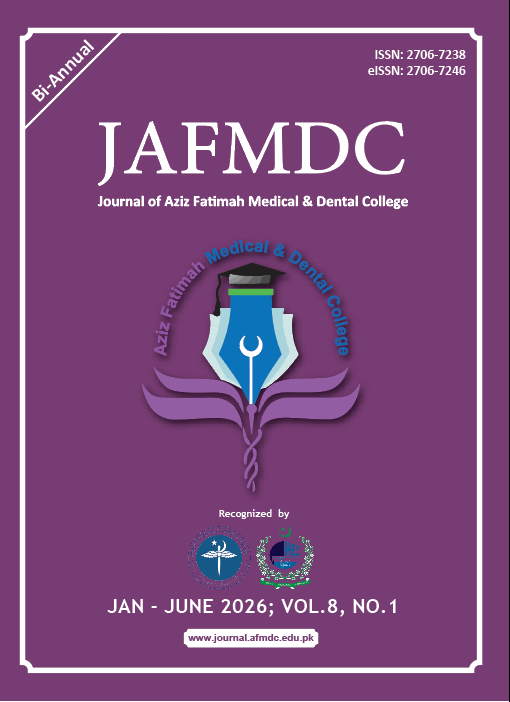
Radiological Assessment of Lumbar Spine Degeneration: Correlation with Age and Lumbar Level in Pakistani population
Lumbar Spine Degeneration and Age Correlation
DOI:
https://doi.org/10.55279/jafmdc.v8i1.526Keywords:
Intervertebral Disc, Lumbar Vertebrae, Osteophyte,, Radiography, Sclerosis, Spine Degeneration.Abstract
Objective: To evaluate the utility of X-rays in grading lumbar spine degeneration and its correlation with age and lumbar levels in the local Pakistani population to enhance diagnostic accuracy and management of low back pain
Methodology: This study examined 59 lumbar motion segments (L1-L5) from 13 male human cadavers aged 21-80 years. Ethical approval was obtained, and only segments without deformities, fractures, infections, or metastasis were included. Radiological degeneration scores were assigned based on osteophytes, sclerosis and disc height from X-rays.
Results: Radiological findings showed increased sclerosis and osteophyte formation with advancing age, while Schmorl’s nodes were observed in 16% of cases. Mean overall degeneration scores, along with sclerosis and osteophyte scores, correlated positively with both age and spinal level. Mean overall degeneration scores showed significant associations with age (p<0.001) and spinal level (p=0.001). Spearman’s rank correlation revealed significant increases in overall degeneration and osteophyte scores with age (p<0.001), whereas sclerosis showed a positive but non-significant association (Rho=0.7). A strong positive correlation was also found between spinal level and overall degeneration (p=0.01) as well as sclerosis scores (p=0.04). Osteophyte scores increased with spinal level (Rho=0.82) but without statistical significance (p=0.089).
Conclusion: Lumbar spine degeneration increased with age, with L5 most affected, while sclerosis and osteophytes progressed independently. Findings support X-rays as a reliable diagnostic tool, aligning with global studies and highlighting the need for further research on Modic changes and ethnic variations.
Downloads
Published
How to Cite
Issue
Section
License
Copyright (c) 2026 Amber Salman, Saba Saleem, Asma Zulfiqar, Munazza Sardar, Muhammad Shahid Akhtar, Faiza Hanif

This work is licensed under a Creative Commons Attribution-NonCommercial 4.0 International License.
You are free to:
- Share — copy and redistribute the material in any medium or format
- Adapt — remix, transform, and build upon the material
- The licensor cannot revoke these freedoms as long as you follow the license terms.
Under the following terms:
-
Attribution — You must give appropriate credit, provide a link to the license, and indicate if changes were made. You may do so in any reasonable manner, but not in any way that suggests the licensor endorses you or your use.
-
Non Commercial — You may not use the material for commercial purposes.
-
No additional restrictions — You may not apply legal terms or technological measures that legally restrict others from doing anything the license permits.