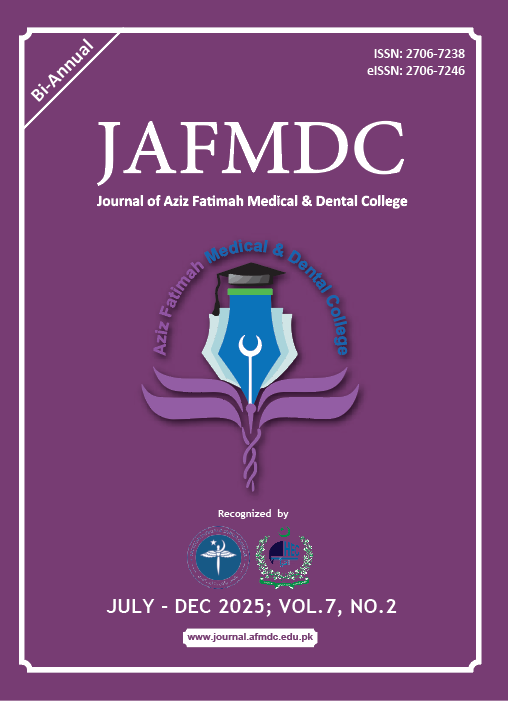
Frequency of Plummer Vinson Syndrome in Patients with Dysphagia
Plummer-Vinson Syndrome and Dysphagia
DOI:
https://doi.org/10.55279/jafmdc.v7i2.473Keywords:
Dysphagia, Esophageal Webs, Iron Deficiency, Plummer–Vinson syndromeAbstract
Objective: To evaluate the frequency of Plummer–Vinson syndrome (PVS) in patients who present with dysphagia.
Methodology: After ethical approval, this cross-sectional study was conducted in the Department of ENT, Allied Hospital, Faisalabad, from July 2021 to January 2022. Patients aged 20 to 60 years who complained of difficulty in swallowing for more than two weeks were enrolled. Patients with dysphagia due to neurological causes or malignancy of the upper digestive tract were excluded. Each patient underwent barium swallow scan and CBC to evaluate for esophageal webs and iron deficiency anemia. Data was analyzed in SPSS version 25, and p less than or equal to 0.05 was considered statistically significant.
Results: The mean age of patients was 37.75 ± 8.35 years. 61% of the cases were within 20 to 40 years of age range. Females were 74.9% of the study population (M:F ratio 1:2.9). The mean duration of symptoms was 5.93 ± 1.46 weeks. Plummer–Vinson syndrome was identified in 24 (8.14%) patients and there was higher prevalence among females (p=0.048).
Conclusion: Plummer–Vinson syndrome is not uncommon among patients who present with dysphagia, and it occurs predominantly in females. Early screening for iron deficiency and timely intervention can prevent complications and malignant progression.
Downloads
Published
How to Cite
Issue
Section
License
Copyright (c) 2026 Khansa Tariq, Danish Hassnain, Hafiz Sajjad Hyder, Kashif Nawaz

This work is licensed under a Creative Commons Attribution-NonCommercial 4.0 International License.
You are free to:
- Share — copy and redistribute the material in any medium or format
- Adapt — remix, transform, and build upon the material
- The licensor cannot revoke these freedoms as long as you follow the license terms.
Under the following terms:
-
Attribution — You must give appropriate credit, provide a link to the license, and indicate if changes were made. You may do so in any reasonable manner, but not in any way that suggests the licensor endorses you or your use.
-
Non Commercial — You may not use the material for commercial purposes.
-
No additional restrictions — You may not apply legal terms or technological measures that legally restrict others from doing anything the license permits.